

Rental Outcomes: Don’t Bust The Guy Breaking Into Your Car?
It was a sunny Sunday afternoon and I was in my car with my kids to get some exercise in. I wanted to shoot some hoops, so I convinced my kids they did too. It was on.
We parked behind a local school and walked over to where the basketball court was on the other side of it; there was also a small playground 50 yards behind the court. My son and I wanted to play basketball. My daughter also initially wanted to play until she didn’t… then she wandered over to the playground.
It became a volley of walking from the basketball court to the playground and then back again. “Dad! Come see this!” “Dad! Over here!”
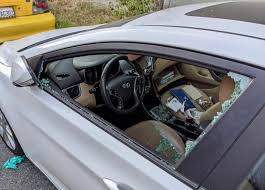
On my sixth trip back to the playground, I realized that if I walked far enough into the playground, I could get the sight view past the school to see my car in the distance (which was completely obscured from the basketball court). And I saw a strange man walking suspiciously around my car. I say “suspiciously” because there were no other cars there. What was he doing? He was looking into my windows and did not know he was being watched. How suspenseful! And what to do?
I went through the options. I could yell and let him know I saw him. That would probably prevent any theft or damage to my car. Yawn & boring.
Or I could go (undetected) back to the basketball courts, stash my kids in the bushes, and then sneak around to potentially catch the stranger breaking into my car. Once he broke glass, I could ambush and subdue him; in a perfect world, I could handcuff him with the zip ties in the back of my car. Then I could call 911 and the Charlotte Observer letting them know that a “local hero” had one criminal on ice waiting for them- no charge.
That would be awesome unless… the stranger was bigger than me, good at fighting, and also included kidnapping as part of his criminal repertoire. Then he might drive away in my car with my kids, and leave me bleeding on the pavement. That would be a major fail and one that would be difficult to explain to my wife.
Seriously, what outcome did I want? Though the hero thing sounded pretty good, I needed to get real for a minute. Despite the appeal of potentially getting a key to the city from Mayor Lyles, what was going to be the cost? Realistically, if all went close to best-case scenario (which it rarely does), I’d have a busted car window (that I’d have to pay for and deal with), be waiting a while for the cops to show up (with my knee in a guy’s back who is probably cussing me out), and be babysitting two young children at the same time. That did not seem like a great outcome, even with the best-case scenario.
To me, property management is about creating good outcomes for our clients; the best outcomes come from tenants who stick around a while and consistently:
- Pay the rent
- Maintain the property
- Get along with their neighbors
We recently got a call from the HOA of one of our condo units where they accused our tenants of unkempt living, namely having a unit so disgusting that bugs where infiltrating the homes of neighboring tenants. This was clearly a violation of #2 and #3 above. This was not good, if it was true. They wanted us to evict the tenants immediately (and if we didn’t, they were sending a Sheriff that night to do so).
Despite the sheer illegality and impracticality of such a threat (landlords wish it was this easy to evict bad tenants- “oh, just call the local Sheriff and have him go over the same day to remove them…”), what outcome did we really want? Did we want to remove paying tenants who never had any prior issues? Of course not. We wanted the tenants to correct any cleanliness issues, if applicable, and then continue to stay and pay rent.
So we contacted the tenants and explained what the HOA alleged. Then we let them know we’d be there for an inspection the next afternoon to ensure the HOA there was no issue. The tenants understood and said there was no problem with that.
The next day, our inspection showed a very clean unit. We thanked the tenants and reported the findings to the HOA. There haven’t been any issues since.
The desired outcome was to keep the tenants, not to try to play “gotcha” to catch them violating the lease. That would put ourselves in a position where we would need to make a decision that no one wanted to make- the costly removal of paying tenants.
Viewing issues from a desired outcome perspective, as opposed to the initial bravado impulse, can help make decision-making more clear. It may be “boring”, but “boring” property management is typically the most effective and keeps the checks coming.
Postscript: So I yelled something at the guy at my car and he left. My son hit some shots, my daughter hit the swings, and then we left (unscathed) in a non-damaged car. Yawn…
Happy Landlording!
Learn More
Property Management: Changes for the Better in 2021?
“Everything in moderation, including moderation.”
Oscar Wilde
“…The man who fears God will avoid all extremes.”
Ecclesiastes 7:18
Let me start off by saying I’m not a big clothes shopper.
I was minding my own business the other day at home and my phone buzzed. I looked down at an alert from Amazon Photos with the “From 10 Years Ago” tag; it was a photo of my beautiful wife and I on a date at a Panthers game (awww…).
Two things struck me:
- Look at that guy with his gorgeous, flowing mane of hair (what happened???)!
- The UNC sweatshirt and wooly I was wearing looked eerily familiar… When I glanced in the mirror, I realized I was currently wearing the same exact outfit. I tend to view these things from an optimist perspective (I still fit in my clothes- nice going! Carolina blue really has always really accentuated my eyes…) as opposed to reality (Buy some new clothes, cheapskate!).
OK, sometimes things should be changed; buying some new attire from time to time never hurt anyone.
And sometimes not changing things can hurt people. In 2020, COVID made changing certain in-person business practices necessary for safety reasons; this really accelerated the use of certain technologies in property management, especially self-showings, video virtual tours, and virtual lease signings. These methods have been used and adopted by many in the industry to varying degrees:
- Self-Showings: This is where a prospective tenant is able to access keys through a lockbox to show themselves a property without a company representative being present.
At first take, it seems risky to have strangers in a vacant home when they could just take desired pieces of the property with them when they leave. But this trend has been building and is now commonplace. I think a real estate agent provides limited value being on rental showings. Renters don’t need to be sold into making a decision. At the end of the day, they are taking time to look at rentals because they either want to or have to move; I don’t see a lot of rental home tire-kickers. They want to like the property and get it done with, as opposed to new home buyers who sometimes look for perfect.
However, there obviously needs to be some controls in place (avoiding the “open-barn” theory). It’s important to know who is going into the house and have some concrete, confirmed contact information that can be given to the police if something goes awry. Done properly and moderately, self-showings are efficient and allow renters to view homes on their own schedule. It can work really well.
- Video Virtual Tours for Rentals: I’m still not on the bandwagon on this one. I really want people to visit the rental in-person so they can make sure it is right for them. If someone wants to buy a home from across the country sight unseen, that is fine with me (we live in America, right?); they can spend their money anyway they choose to. But if they wind up disliking the home after purchase, they have no one to complain to. With rentals, they can complain to their landlord for a year or more. No thanks!
I want to provide enough information for people to decide if they want to see the property (pictures, accurate property information, price, etc.). But I’m still not convinced that videos can replicate being there. I also want to be cautious abut adding an expense to our owners to get a tenant we may wind up in a forced bad relationship with (“I don’t like the neighborhood”, “The building is too loud”, or “You purposely videoed away from the wall in the dining room to hide the scuff marks.”).
- Virtual Lease Signings (E-signing Documents): I like this trend, to a point. We’ve used it for a few years for lease extensions with existing tenants and paperwork for our owner clients who needed to add properties. Since COVID, we have even started to e-sign the lease documents prior to meeting the tenants at the property to give them the keys as a precaution.
However, I think this trend has gone too far. It seems like it is a ready excuse not to talk or meet. I like to meet with the tenants and review the lease in-person. There is value to attaching a person with a (masked) face. If we’re going to the property to get our sign and lockbox anyway, why not (safely) say “hello”?
Anyway, in property management and in life, change isn’t always good or always bad- and it often does not need to be wholesale! Treading moderately with new technologies can be the best path forward.
So I think that means I can still wear the sweatshirt and wooly as long as I mix in some new pieces of clothes occasionally, right?
Happy Landlording in 2021!
Learn More
Renters: It’s Not You, It’s Me…
In the annals of relationship-ending conversations, there are many flavors:
Reflective: I think I may hate you
Cooperative: We just don’t complete each other
Corporate: We need to divest
Dramatic: “This” (hands motioning in a circle around both parties) isn’t working for me!
Conditional: We need to either work harder at this or start seeing other people
Non-Committal: I’m not sure about us
Cold: You are altogether awful! Leave me alone forever.
Soft Approach: It’s not you, it’s me!
When a relationship has to end, it’s hurtful, and usually to both parties. People put themselves out there and are vulnerable. It’s tough. And there’s no good way to part ways, even when it has to be done.
In a less personable way, it’s the same situation between renters and property managers.
Renter: This rental house on-line looks enticing!
Property Manager: Come and see it in person!
(later)
PM: Did you like it?
Renter: It smells and is way over-priced! If you think it is the “best house on the street”, you may be as dumb as you look.
PM: Fortunately, I’m not that dumb… I’ll notate your response as “not interested at this time”.
But when the tenant response is favorable…
Renter: I love it! I’ll fill out a rental application!
PM: Woo-hoo!
(later)
PM: Your results are in and things look really good. But, unfortunately, you’re not approved. Thanks for applying.
Renter (confused): What???
PM: We’ll, it’s not you, it’s me!
Renter: Seriously??
Sadly, yes.
The problem is that in Charlotte’s hot real estate market, property managers can get 10-15 different applications for certain homes (typically single family homes $1,300.00/month or less). This makes it tough to pick a tenant. Some of the applications have undisclosed evictions and can be weeded out quickly, but several of them are usually really good. If we had five of the rental house, we could fill them all. But we only have one. And that creates unhappiness for the parties who are not approved for the house, even when they are very “dateable”.
It truly is me, not you. It’s nice to be landlord in this Charlotte market from a vacancy perspective, but we can certainly understand the renter frustration of not getting a house with normally acceptable credentials. It’s tough!
Happy Landlording!
Learn MoreCharlotte Property Management Monthly: Landlords- 5 Reasons Why Our Time Is Now
Wow! Has it already been over five years already since the real estate market tanked? TARP, the “new normal”, bailouts, CDO’s, and toxic assets were all the rage back then. Home buyers disappeared, home sellers were really unhappy, and real estate prices dropped like a rock. Renters were deemed the smart folks, and landlords, not so much.
It was a tough time for most people as the economy soured and landlords were no different. Rental rates were relatively low, almost no one could get a mortgage to refinance, and people (landlords and tenants included) were losing their jobs. This affected landlords in two ways. First, if they lost their job, they still had to pay for their home and their rental homes. And, secondly, if their tenant lost their job, they had to deal with that situation as well. The uncertainty made for tough times for all involved. Many landlords got out of the rental business either by choice or by economic necessity.
However, the times have changed in almost every way for the better now. The rewards for hanging in there the last five years seem to have arrived and I’m seriously wondering if we are entering into a golden age for landlords. Wait- What??? Why would someone vested in real estate for his livelihood make such an outrageous claim? Well, let’s look at the facts on the ground:
1. Rental rates keep on rising. Love you, extra cash flow!
2. Mortgage rates have dropped even lower making leverage really cheap. Locking into low interest rates is fun!
So, higher rents coupled with lower mortgage costs equals bigger profits for landlords. Sweet!
3. Home prices are still low and seemed to have bottomed out. For landlords with cash, they can pick up rental homes on the cheap that will immediately cash flow and be primed for a quick equity build-up when the market recovers. There are undoubtedly still more sellers than buyers in the market.
4. The rental market is healthy and homes are filling quickly with higher quality tenants. Many great former homeowners who hit a rough spot are now clamoring to live in rental homes on the market today. They pay on time and maintain the homes extremely well. They know the drill and are great to work with!
5. Being that it seems that home prices have stabilized (and with inflation coming at some point in the near future), home prices will begin to work their way up again. So the landlords who have held on and been paying down their mortgages over the past five years, will be rewarded with equity (cash) in a liquid market.
So, as a landlord, you should be excited! Our time is now!
Brett Furniss is the President & Owner of BDF Realty (Charlotte Property Management) and Rent-To-Sell Realty (“When You Need a New Solution to Sell Your Home”) which specialize in rent-to-own (lease options) and rent-to-sell homes. His newest book, A Real Estate Agent’s Complete Guide to Representing Rent-To-Own (Lease Option) Tenants (Delight Clients, Fill Vacant Homes, and Earn $2,250* Upfront! (*Minimum!)
Learn More
Charlotte Property Management Weekly: David vs. Goliath: Punish Those with No Credit or Landlord History?

Everyone knows the biblical story of David versus Goliath. David, a young shepherd, takes his slingshot and takes out the menacing giant, Goliath, with one shot. Then he picks up Goliath’s sword and cuts off Goliath’s head with it, saving Israel from the Philistines as a result. Pretty good work for an amateur!
In the world of property management, “David”, the prospective tenant, is often put on the sideline per se. See, David will probably be a good renter, but it can’t be proven. He has no credit score (works at a restaurant and pays with cash) and no landlord history (besides Mommy, Daddy, and his undeserving ex-girlfriend). With no provable payment or rental history, he is the great unknown. To take Shakespeare into the rental world, “To rent or not to rent to him, that is the question.”
Our property management firm uses four criteria to screen tenants:
1. Credit report
2. Criminal background check
3. Landlord history
4. Income and employment verification
So, let’s play this out. We’ll go off the assumption that David is employed, makes enough money to afford the rental home, and isn’t a (known) criminal. We know that he has the money to pay the rent each month. But we still have no idea if he actually will.
Property managers are tasked with proving to their owner clients that they did their due diligence in the screening of prospective tenants that may rent their home. That’s obviously fair. But in a world of limited information, how can David get approved? The easy thing to do would be to reject the application due to having insufficient information to make a decision. This is a common practice in everyday life. For example, this issue was a big reason why President Obama was elected, right? President George W. Bush went to war against Iraq with insufficient information about WMD’s and look where that got him. Most Americans (see polling numbers) wish he had waited for more proof!
So application rejection is a warranted (and defendable) action; if the information isn’t there to make a well-informed call, it needs to be denied. This will cover the property manager if something bad happens, right?
Or, let’s wait a minute. Hasn’t everyone been in this situation once in their life? Does a generation of new renters deserve to be shut out because property managers can’t figure out how to adequately assess their suitability to rent?
I don’t think so. I’ll approve David’s application if he:
1. Passes the aforementioned four screening methods that he can actually qualify for
2. Shows attentiveness and responsibility during the application process
3. Has the wherewithal and willingness to put down additional security deposit monies (this will mitigate the additional risk of insufficient application information)
Israel didn’t shut out David from saving them, even though he wasn’t an experienced soldier. Don’t automatically reject renters of unknown quality; most will turn out to be pretty good tenants!
Brett Furniss is the President & Owner of BDF Realty (“Charlotte’s Most Innovative Property Management & Investment Company”), and Rent-To-Sell Realty (“When You Need a New Solution to Sell Your Home”) which specialize in rent-to-own (lease options) and rent-to-sell homes. His newest book, A Real Estate Agent’s Complete Guide to Representing Rent-To-Own (Lease Option) Tenants (Delight Clients, Fill Vacant Homes, and Earn $2,250* Upfront! (*Minimum!)
Learn MoreCharlotte Property Management Weekly: Your Rental Home Wants You to Wait Until It’s Ready

Every client we’ve ever had has wanted as little vacancy time for their rental as possible. Zero days are optimal; every day after zero winds up costing them money in utilities, mortgage payments, and maintenance. Not wanting to lose any money leads to a mentality of getting the home on the market as soon as possible, regardless of condition and resident situation.
So some clients want us to put their homes on the market prior to them being ready for occupancy. What I mean by this is that the home has not been completely repaired and there are still personal items in the house. They (or their current tenants) also are within the process of moving.
The rationale, by itself, is sound. The greater the length of time the house is on the market, the greater amount of potential tenants that can see it. If more potential renters see it, the law of large numbers would dictate that someone at some point would love it and want it.
However, does this really work? I would argue it doesn’t. Huh? Why’s that? Isn’t it common sense?
Simply, the American consumer’s mind works differently now. There is an inundation of information being flung at them on a constant basis. Most of it is ignored; however, there are some marketing messages that get through (like a rental listing). If the consumer takes the time and makes an inquiry to visit the property, there is typically one shot to get them. Their attention span is limited.
This one shot means that the house has to look perfect. This visit needs to conclude with the prospective tenant loving the house. If they see or feel something they don’t like, it will probably turn them off and they will want to find another home. And there are many other rental houses on the market that look very similar. The competition is fierce!
So why does this matter? Maybe the diamonds in the rough that aren’t turned off by the home’s uncleanliness will be unearthed and they’ll take it. It’s certainly possible. But are renters who don’t care about the condition of the home desirable? If so, there may be disappointment when move-out time arrives and the home doesn’t look so great. Clean people typically want clean homes.
The other main reason is that once the marketing of the property begins, momentum is started. The rental is on the top of all the searches from rental websites, people who are waiting for a rental are told about it by their property managers, and it is fresh. This is when things typically happen for an average rental home- the first two weeks. Interested calls, inquiring e-mails, and subsequent showings come quickly. They need to be harnessed and converted into applications and security deposits.
But when the rental house isn’t up to the task, momentum is stunted. Interested, potential renters see the property in less than ideal shape and compare it to better kept homes on the market. The home loses out. Or the current tenant in the home is packing boxes to move and glares at the renter who is interrupting their evening after work. The house looks horrible and the vibe is bad. Potential renters flee to the next home. Can you blame them?
With rental homes, it’s more about quality time on the market and less about total time. Make sure the rental home is ready and most inviting when the most people want to look at it!
Brett Furniss is the President & Owner of BDF Realty (“Charlotte’s Most Innovative Property Management & Investment Company”), and Rent-To-Sell Realty (“When You Need a New Solution to Sell Your Home”) which specialize in rent-to-own (lease options) and rent-to-sell homes. His newest book, A Real Estate Agent’s Complete Guide to Representing Rent-To-Own (Lease Option) Tenants (Delight Clients, Fill Vacant Homes, and Earn $2,250* Upfront! (*Minimum!)
Learn More