

Wesley Snipes’ IRS Case for Rental Home Inspections

Wesley Snipes is a great actor. Watching him in White Men Can’t Jump, Major League, and other films is some good theater.
But Wesley got some bad advice at tax time in the late 90’s. His accountants told him there was a loophole that would allow him to avoid $7M in taxes; in fact, he didn’t even have to file tax returns. He thought that sounded pretty good. And besides, everybody knows the IRS isn’t really paying close attention with the sheer amount of returns they have to log every year.
Well, the IRS was paying attention. And they got Wesley’s attention with a 3-year prison sentence that ended in 2013.
It was sad for everyone: his many fans, his accountants (who received even stiffer jail sentences), the IRS who had to use limited resources to prosecute his case, and especially for Wesley (who had reputedly earned over $40M from 1999-2004).
There were a lot of questions in Wesley’s case, but one almost undeniable certainty- Wesley’s tax returns now are the most truthful and timely documents he files every year.
This logic spills over into residential property management and periodic home inspections. If landlords can show tenants that they are paying attention to what is going on in the house and whether maintenance is being done, they will undoubtedly get a better conditioned house when the tenant eventually vacates.
So, yes, this means going over to and inside the rental house. I’d highly recommend giving the tenant a week or so notice of when the home inspection is and letting them know what you are specifically planning on looking at (e-mailing them a list is helpful).
Q. What should a landlord include in their home inspections?
A. Anything they care about.
Some general things I care about:
- Do the keys still work?
- Is the lawn and landscaping being kept up?
- Are the air filters being changed?
- Are the fire and CO detectors still there on each level of the house and are they functional (aka is the tenant changing the batteries when they die?)
- Is the home clean?
- Does it smell like smoke?
- Is there evidence of a pet if there isn’t supposed to be one?
- Does anything look weird?
Feel free to add anything else of interest. I also think conducting the home inspections twice a year (roughly on month 3 and month 9 of the lease) works well. Paying attention is good, stalking is bad.
Wesley has some well-maintained tax returns now and periodic home inspections should lead to some well-maintained rental homes.
Happy Landlording!
Brett Furniss is a property manager at BDF Realty (Charlotte Residential Property Management), the trusted real estate advisor for Charlotte landlords & Home of $100 Flat Fee Property Management. BDF Realty utilizes their innovative Pod System for exceptional customer service in residential property management, home repairs, and home sales for single-family homes, Uptown condos, and town homes in the Charlotte-Metro Area. Contact Us Today!
Learn MoreLong Term Real Estate Planning is (Politically) Correct!

If you knew you were running for president someday, you’d probably do many things differently. You may rethink all your controversial letters to the Charlotte Observer loudly demeaning the local politicians (those idiots!!); you may need their help someday campaigning on your behalf. That Election Day when you were in the throes of a “House of Cards” marathon, scarfing down Jet’s Pizza, and didn’t quite feel like driving to the polls? Better get up, wipe the sauce of your mouth, punch your chad, and make it look like you care about the political process! The video your friend made of you acting like a fool with the pool boy on that cruise a few years back? Better make sure that doesn’t find its way to Facebook because Glenn Beck will have a field day with it during the primaries.
This whole accountability thing can be scary! But if you know what you want to do in the future, you can plot your moves (and non-moves) and optimize your future plans.
Real estate works the same way and requires taking a long term planning view. What do you want your real estate to accomplish for you? And over what time period?
From being a Charlotte property manager for over a decade, we’ve had clients who have had many differing reasons why they are holding real estate. We try to put together a strategy to cater to these needs individually. Here are a few examples:
- “I have a house that I don’t have enough equity to sell right now. I want to rent it out until the market turns up again.”
With that in mind, we want to minimize fix-up costs (touch-up paint & carpet steam clean when turning over the property between tenants) before we see the market improve. Once it does, we’ll look to replace the carpet and give the home a full paint job to sell at the top of the market.
2. “These houses are my retirement. I want to keep them forever and live off the residual income.”
We’d look to find long-term tenants on the private market (multi-year lease only) or Section 8 tenants (who now, after 18 months of vacancy in one house, cannot move until they leave the program). We’d also look to more actively make optional repairs to maximize the enjoyment of the tenant.
3. “I want to have the option to stay in or get out depending on market conditions!”
We’ll keep you apprised of the market sales and rental prices 60-75 days prior to the current lease expiration. Then you can let us know which way you want to go, rental or sale. We’ll also let you know when an opportunity comes up when one of our investors is looking to buy an investment home with a tenant already in place to create a win-win for both of you.
The best way to get the outcome you want tomorrow is to wisely plot your moves (and non-moves) today. There are very few people who are politically incorrect, like Donald Trump, to whom this (apparently) doesn’t apply! But, in real estate, long term planning will save you both time and money.
Happy Landlording!
Brett Furniss is the head property manager of BDF Realty (Charlotte Residential Property Management), the trusted real estate advisor for Charlotte landlords & Home of $100 Flat Fee Property Management. BDF Realty utilizes their innovative Pod System for exceptional customer service in residential property management, home repairs, and home sales for single-family homes, Uptown condos, and town homes in the Charlotte-Metro Area. Contact Us Today!
Learn MoreSection 8 Program Worth Revisiting? A Definite Maybe

No one really liked Janie. And there were a lot of reasons why. For a teenager, she was pretty much a know-at-all. Stubbornly obnoxious. She would not let you get a word in edgewise. Always right. Rude. Cocky. Maladjusted. And that was just her award-losing personality. And physically? Her scrawny frame, big glasses, and overflowing braces (often full of food scraps) made her equally unappealing.
Now fast forward 5 years in the life of Janie. After years of dejection, she has softened a bit. Instead of looking completely past you before beginning her monologue on her life’s recent happenings, she’ll toss a few platitudes your way that make you feel a small connection. “How are you doing?” “How’s your brother? “You get that mole taken off your back yet?” She’ll still take the last doughnut off the plate in front of both of you, but now she’ll pause and feign a glance your way for approval. She still texts constantly when you talk, but now raises her head for momentary eye contact when you bring up your mother’s cancer treatments. And her scrawny body has filled out, she started wearing contact lenses, and has a nice straight smile now; some may say she isn’t bad to look at, relatively attractive even.
But Janie’s not for everyone. Maybe not for most people. But some people “get her” and even go out of their way to be around her. Some of your friends have even dated her.
Ever know anyone like that?
The Section 8 program is like Janie in a way. Several years ago, I wrote how we needed to get our landlords out of the Section 8 business because it was impossible to get a good ROI for our owner clients. As a Charlotte property manager, we couldn’t cost justify the lower rents, costly repair items, poor communication, and overall effort needed to recommend the program. And I still get a little queasy thinking about it.
As a footnote, we do have clients that have kept their homes in the Section 8 program. The owners allowed the tenants to keep renewing their leases (most at significantly below market rates) and the Section 8 tenants chose to do so. The advantages to our owners are continued rental payments and not having to fix-up their properties to get them market-ready for new tenants. The negatives are that as Charlotte rental rates have been going up 5-10% annually, Section 8 has capped their permitted rental increases (if approved) to 2% annually (in real numbers: $900 monthly rent = $18.00 rent increase- not much to get excited about). Section 8 also conducts annual inspections which almost always lead to an owner repair bill; some of the items would never have to be repaired if the house didn’t have to meet many government regulations (re: peeling paint on ceiling, etc.).
However, in the past 6 months, Section 8 has enacted 2 changes that I thought were very landlord friendly:
- Locking a tenant into a property if they have lived there for 18 months. The owner has the option of not renewing the lease, but the tenant does not have the option of moving if they want to stay in the Section 8 program.
- Changing house inspections from annually to biannually. So, now the repairs only have to be made every 2 years (which is a huge deal for landlords who have gone through the nightmare of rent abatement for multiple inspection failures).
This still doesn’t make Section 8 work for everyone, but it might start making sense for some people. And as responsible property managers, it is something we will need to consider recommending again for certain owners (risk averse) and certain properties (difficult to fill, long term investment holds, areas of historically low rent appreciation). While the private rental market might be compared to the stock market (higher yields, more volatility), the Section 8 market might now be compared to the bond market (lower yields, steadier income).
So… your best buddy saw Janie the other day and said she was looking good and they had a nice chat. He said she asked about you. Your stomach still churns when thinking about your past dealings with her, but since she’s interested, maybe she’s worth meeting up for coffee? Maybe she’s changed?
Anyway, it’s something to think about- a definite maybe. Happy landlording!
Brett Furniss is the head property manager of BDF Realty (Charlotte Residential Property Management), the trusted real estate advisor for Charlotte landlords & Home of $100 Flat Fee Property Management. BDF Realty utilizes their innovative Pod System for exceptional customer service in residential property management, home repairs, and home sales for single-family homes, Uptown condos, and town homes in the Charlotte-Metro Area. Contact Us Today!
Learn MoreTalk to Your Tenant: Win-Win is Better Than Lose-Lose, Right?

Years ago, there was a small, remote island that was relatively non-descript and unnoteworthy. Then two multi-billion dollar pharmaceutical companies decided their business’s future hinged on acquiring it.
Why? Its climate and soil composition was ideal to grow a certain tree that had revolutionary medicinal value. The pharmaceutical companies needed to harvest and grow and lot of these trees and this was the only place where they could find the perfect conditions to do so.
So what happened? These heavyweight industry titans went after each other to procure this island resulting in a bidding war (hundreds of millions for dollars over a nominal asking price), lawsuits, threats, and tons of bad blood. After millions had been spent and not one tree had been harvested after a year, a level-headed senior executive suggested the use of a mediator. People had their doubts because the companies were so tight-lipped about trade secrets; they wouldn’t divulge anything about their intended use of the trees.
As the story goes, the mediator ironed out a deal within an hour. All lawsuits were dropped, conversations turned from sharply bitter to excitedly collaborative, and the rivals eagerly bought the island together in joint ownership. They were both in production within 6 months.
What happened? Both pharmaceutical companies still needed the trees, but the first only needed the leaves the other only needed the bark. Once this was discovered, both pharmaceutical companies were in business! Adversaries became profitable allies.
It was a pretty simple solution, right?
Communication is important, especially in the property management business. And, conversely, non-communication can be very expensive and time consuming!
A rental relationship can thrive with good communication and turn seemingly lose-lose arrangements like a tenant needing to get out of his lease into win-win situations. Here are a few examples:
A tenant wanted to get out of his lease early due to a job loss during the spring and the owner wanted to sell. This turned out well as the tenant paid an extra month of rent to terminate their lease and the owner had a vacant month paid for while the home was being fixed-up during an active spring/summer sales market.
Or a tenant was a landscaper and needed an extra month to vacate. The owner wanted to sell immediately, but allowed for an extra month of renting. For this negotiation, the tenant landscaped the yard for free before vacating. This gave the tenant the time they needed, while saving the owner money for fixing up the yard.
These types of win-win negotiations are only possible when landlords and tenants talk and find out the best path forward together. A good property manager makes sure that these issues are fleshed out and potential solutions are vetted thoroughly.
Anyone can take a hard line on a lease and impose their will legally. But this is rarely the best and most profitable path.
As a postscript to the initial story, the big loser was the owner of the island. Through incomplete information, the island owner almost achieved a huge, unnecessary payday. In the property management sphere, the island owner is usually the lawyers who are paid to enforce the lease.
So talk to your tenant! Good things can happen and can turn seemingly lose-lose scenarios into win-win.
Happy landlording!
Brett Furniss is the head property manager of BDF Realty (Charlotte Residential Property Management), the trusted real estate advisor for Charlotte landlords & Home of $100 Flat Fee Property Management. BDF Realty utilizes their innovative Pod System for exceptional customer service in residential property management, home repairs, and home sales for single-family homes, Uptown condos, and town homes in the Charlotte-Metro Area. Contact Us Today!
Learn More
Do Your Rental Home Repair People Care? 2 Lessons Learned

“People don’t care how much you know until they know how much you care.”
Theodore Roosevelt
“We have met the enemy and he is us.”
Walt Kelly (Pogo)
When you’re in the property management business, many different things in houses will break. It’s a sad reality, but it is also the reality that keeps property managers in business (so we keep our complaints to a minimum!).
Contrary to popular thought in Charlotte, we really don’t know everything (please laugh!). So like most property management companies, we employ repair professionals to work on things that break (plumbing, roofs, appliances, HVAC, painting, etc.). They are, in effect, an extension of us at BDF Realty.
So how do we know if the repair people we use are any good? The simple answer is if things are fixed and tenants are not calling us to say their issue did not stay resolved. And if the issue recurs (which happens to the best of them), how does the repair person handle it? Do we get charged for another visit to the house? Do these recurring issues happen often? How long does it take for them to get back to do the repair again?
So skill-wise, we can figure out if a repair person is any good in a reasonable amount of time. Let’s call those the hard skills. But what about the soft skills? Are they kind? Conscientious?
Do they care?
That’s tougher. We can’t go on every service call with our repair people. And if they can’t at least fake being nice and caring during those calls, they weren’t going to last anyway. So how can you tell if they care?
I’ve learned 2 lessons over the years:
- If any tenants call to complain about a repair person, there is probably something wrong with the repair person. Two calls and there is definitely something wrong.
It takes time and effort to locate the property manager’s information, call them, and detail your experience without sounding like a whiner. Most tenants don’t care enough unless something is really off.
Several years ago, I used a really nice, reasonably priced handyman to work on many of our homes. When I would see him in person, he was sharp as a tack and would bend over backward to resolve issues. But I started getting a few tenant calls about chronic lateness and “shady” people he was bringing with him to work on jobs. We had to sever ties with him. He’s still a nice guy, but he just didn’t care enough to show up on time and be professional.
- If the repair person is treating us poorly, chances are they are doing the same to the tenants.
Recently, we had a repair person work on an issue at a vacant home for us. We gave him the lockbox code so he could get in and do the work. The next day we were at the property and found the house key in the lockbox, broken in half. We called the repair person and he said he had broken the key in the lock and forgotten to call us about it.
To me, that’s sort of a big deal, but not the key breaking per se. I will be the first to tell you that things happen. As Charles Swindoll said, “Life is 10% of what happens to me and 90% of how I react to it.” I’m not going to give someone a hard time over things breaking; truthfully the lock was tough and anyone could have broken a key in it. But not thinking it was important enough to let me know immediately about? I have to ask, “Does he care?”
Having repair people that care matters. Being a property manager who cares is important too. And the two are exactly the same to the tenants we serve.
Happy Landlording!
Brett Furniss is the head property manager of BDF Realty (Charlotte Residential Property Management), the trusted real estate advisor for Charlotte landlords & Home of $100 Flat Fee Property Management. BDF Realty utilizes their innovative Pod System for exceptional customer service in residential property management, home repairs, and home sales for single-family homes, Uptown condos, and town homes in the Charlotte-Metro Area. Contact Us Today!
Learn MoreWho Pays Incidentals When Things Break? A Rental Home Dilemma

The Situation:
The tenant (Mitch) has received higher-than-average water bills for the past two months. He calls his Charlotte property manager who sends out a plumber to investigate. The plumber says there is a pipe cracked underneath the driveway that will cost $2,500.00 to fix.
Mitch’s take on the situation:
“I just rent here. My water bill is usually $60.00/month. The last 2 months it’s been $150.00/month. So, I’m out an extra $180.00 at no fault of my own. I pay my rent on time every month and don’t have the budget to afford this. If you ask me, the owner is lucky to have a tenant like myself that doesn’t cause any problems.”
Bottom line: Mitch requests a $180.00 reimbursement from the owner for excessive water expenses.
The owner’s take on the situation:
“$2,500???? The rent on this place is $1,050.00/month, so I’m looking at 2.5 months of rent down the drain. How does a pipe crack happen under a concrete driveway?? And the tenant wants an additional $180.00? Please let Mitch know that I didn’t burrow under his driveway a few months ago with a hammer and smash the pipe. Let me get back to you on where I’m going to get the money to pay the mortgage and for this pipe leak. I think there is assumption that because I’m the landlord, I have millions of dollars sitting around for this type of stuff. Not true!”
Bottom line: The owner does not look at Mitch’s request (or the entire situation) favorably.
So who pays the incidental water expense?
First of all, this is a bad situation for everyone, with the exception of the plumber. The tenant has higher water bills at no fault of his own. The owner has a broken pipe at his house (and an unhappy tenant) at no fault of his own.
In life, things break. And things sometimes break with no one at fault. We’re in a society that expects 100% uptime on everything, but that is a fallacy in a world where things wear and rust out. And when things break, there is cost and (usually) a mess to clean up. And everyone expects some other party to pay for it (not me!!).
So we have to go to the lease for guidance. Most standard leases that I’ve seen say that unless there is “willful or wanton negligence” on behalf of the landlord, landlords are not responsible for incidental damage from things breaking. (Note: I’m not a lawyer and don’t even play one on TV)
If the landlord sent someone to fix an issue in a reasonable amount of time, he should be in the clear from having to pay additional costs beyond the repair. That’s not to say there may not be additional factors involved that may compel the owner (or tenant!) to offset the other’s financial outlay. But, normally speaking, the lease seems to offer this protection to the landlord.
So, if you are the tenant, what to do? If Mitch has renters insurance (which is a requirement of our leases), he has another venue to ask for relief from.
We’ve had other similar examples: a hot water heater leaking on to a laptop, food being ruined from a refrigerator breaking down, and others. To the tenant, it is a loss of a computer or replacing spoiled food; to the landlord, it is buying or repairing a hot water heater or refrigerator. Ugh!
Bottom line: When things break, it is not a good situation for anyone. But realize that it is a part of life that is 100% guaranteed to happen to you many times. Try to be civil and understanding when it does. Neither party likes it!
Happy Landlording!
Learn MoreSatellite Dish Installation on Rental Homes: An Innocent Request?
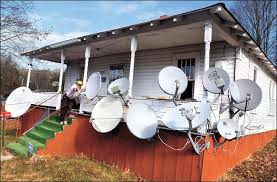
There is a potential danger lurking in your rental home. It may seem innocuous, but it can bring lots of shady characters and dangerous ideas into your tenants’ lives. It never sleeps, relentlessly pushing its own agenda and standards on to its unsuspecting victims.
It’s satellite TV. And the same moral danger exists to all of us.
But, alas, we live in a democracy and can’t really control what people choose to watch.
However, I do want to talk about the hardware- satellite dishes. We get relatively innocent requests from tenants:
Tenant: Hey Brett, we mailed the rent check today.
Me: OK. Cool. Thanks!
Tenant: And there was something else. I’m really getting into FanDuel fantasy football and want to get the NFL package from my satellite provider, so I need you to sign a form that gives me permission to put a dish on the roof.
Me: OK. But I’m pretty sure there is already a dish up there.
Tenant: Yeah, but it’s not the right one. We need one from this other carrier.
Me: OK. But are they taking down the other dish and making sure that the one they are putting up is coming off too after you vacate?
Tenant: I don’t think so…
Me: OK. I’m pretty sure dishes aren’t like flowers; they don’t look that great and involve drilling into the roof and stuff. I’m not sure we really want to be collecting dishes up there?
Tenant: You’re saying “OK” a lot, but have not yet said “OK” to the dish…
Every landlord wants tenants to (legally) enjoy their rental homes. But what about these dish installation requests?
As Charlotte property managers, we typically recommend saying “OK”. But we also add the following caveats that need to be agreed to in writing:
- The tenants are responsible for any damage the dish causes
- The tenants are responsible for having the dish and all the wiring taken down when they vacate
We’ve taken over management of rental homes that have had 4(!) dishes installed on them. It’s not pretty.
So, we’re not trying to tell anyone what they can watch, but we are making sure the venue they are watching their NFL package in is protected.
And good luck in FanDuel! But please don’t bet the rent money on your line up, OK?
Brett Furniss is the head property manager of BDF Realty (Charlotte Residential Property Management), the trusted real estate advisor for Charlotte landlords & Home of $100 Flat Fee Property Management. BDF Realty utilizes their innovative Pod System for exceptional customer service in residential property management, home repairs, and home sales for single-family homes, Uptown condos, and town homes in the Charlotte-Metro Area. Contact Us Today!
Learn More“Unverifiable” Rental Tenants Can Be Like Rudolph and Save Your Christmas

“All of the other reindeers used to laugh and call him names. They never let poor Rudolph play in any reindeer games.
… then all the reindeers loved him, and they shouted out with glee (whoo-pee!). Rudolph the Red-Nosed Reindeer, you’ll go down in history!”
Rudolph the Red-Nosed Reindeer by Billy Gilman
Rudolph had a tough gig before becoming a legendary Christmas icon and saving Christmas one year. Piecing together various biographical sources on Rudolph, it is clear he had a privileged, yet difficult, childhood. Through his envied bloodline (the son of famed Donner and the beautiful doe, Mrs. Donner), he had both the connections and proximity to Santa to have a great life and career. But the dreaded red nose seemingly doomed him to a life of ridicule and parental shame leading to his estrangement from the North Pole elite. He found solace in the company of societal undesirables (among them a dentist!) before the serendipitous approach of uncommon foggy weather one Christmas Eve. Santa took a chance on him and it paid off in spades. The rest, as they say, is history.
When Rudolph was on the road with the undesirables, no one really knew his skills and upbringing (the bloodline, the advanced reindeer training, his untapped flight ability, etc.); they just knew he was sad, unwanted, and unloved. He couldn’t pull out his press clippings from his pockets (no pants) or pull it up on the internet (no Wi-Fi on the Island of Misfit Toys). And he didn’t really want to talk about his past, which recently included not even saying goodbye to his girlfriend, Clarice, the only one who really liked him for who he was (red nose and all). He only had his focus on the future as he was trying to find himself amidst new circumstances.
Rudolph was a great reindeer; he just couldn’t prove it.
As Charlotte property managers, we get applicants who could be great tenants, but they can’t prove it. And we want to be sure they would be before we approve them to live in one of our client’s rental houses, but the applications sometimes don’t reveal much.
For example, on our four main tenant screening requirements, we may receive a prospective tenant application with the following information:
- Credit report: very little to no credit history
Tenant explanation: “I don’t like debt. I pay everything with cash.”
- Landlord history: scattered to none
Tenant explanation: “I lived with family or moved in with a significant other. I was not on a lease or a mortgage.”
- Criminal report: nothing comes up
Tenant explanation: “I’m an outstanding citizen!” (Kudos!)
- Income: no paystubs available
Tenant explanation: “I’m a small business owner or do work under the table.”
So what to do? Much like Rudolph, there’s very little information to go on. The tenant is basically “unverifiable”.
This is where it is easy as a property manager to punt and just reject the applicant. There are a lot of fish in the sea and a verifiable tenant will probably be in contact soon. Besides, there is a lot to lose. If the unverifiable tenant pays rent and everything goes fine, then everyone is happy. But if things go south, clients will understandably ask for details about the tenant screening. “What do you mean you accepted a tenant with no verifiable information? Remind me why I hired you???? Did you flip a coin on whether to approve them?”
So what to do?
- Verify everything you can. Get bank statements and W-2s. Money is usually traceable in some form.
- Collect 2 months security deposit and as much upfront rent as possible in certified funds.
- Ask a lot of questions and do Google searches. Unconventional tenants can require unconventional screening methods. What does their social media accounts say about them?
We’ve found some great, long-term tenants that other landlords have rejected due to them being unverifiable. We’ve also walked away from some that we just couldn’t get a good read on.
Santa gave Rudolph a chance, and Christmas was saved. It is sometimes wise to give unverifiables a second look so rent is coming in during Christmas on your rental home.
Happy landlording!
Brett Furniss is the head property manager of BDF Realty (Charlotte Residential Property Management), the trusted real estate advisor for Charlotte landlords & Home of $100 Flat Fee Property Management. BDF Realty utilizes their innovative Pod System for exceptional customer service in residential property management, home repairs, and home sales for single-family homes, Uptown condos, and town homes in the Charlotte-Metro Area. Contact Us Today!
Learn More
“When To Evict Or Not To Evict”, That Is The Question
“I’ll gladly pay you Tuesday for a hamburger today…”
Wimpy
“I will have the rent for you next week- guaranteed!”
Late Tenants
As a property manager in Charlotte, collecting rent is obviously one of our main functions (in my opinion, the most important function!). Our primary job is to create the most favorable ROI for our clients; we need to be taking rent in for this to be a reality. When we are collecting rent on time and in full, all things are typically good with our owner clients. If a tenant is not paying, things aren’t so grand. And we like things to be grand with our clients!
When a tenant doesn’t pay, eviction is always a last resort. It’s costly, time-consuming, and stressful. And, to boot, the tenant will usually tell you they are going to have the money for you next week! The mind games begin. You can surely hold out until next week to get paid!
But then next week comes and there is a new excuse. “My paycheck was shorted!” That’s one when you don’t feel that badly about going the eviction route. But when the tenants pull out the big guns like, “My mother is dying and I had to use the money for the rent to fly out to see her one last time (the last time I saw her 2 years ago, we said things we both regret- I couldn’t leave it like that). I had no choice… But I get a bonus next week from work and will pay you then!” That’s tougher.
We get calls from home owners who have tenants who haven’t paid for 6 months. Once they get that behind, they’re never going to get caught up.
So what’s the answer? At what point should eviction be filed?
First of all, bad things occur and many tenants are going paycheck to paycheck. When a big expense (aka major car repair) happens, the money just isn’t there for that and the rent.
But most people get paid twice a month (the 1st and the 15th). Filing for eviction prior to the 16th day of the month doesn’t allow you to get those funds. So I believe filing for eviction on the 16th is the earliest point in which it makes sense to do so.
If they aren’t able to make good by the 16th, the next factor to look at is the tenant’s income from when you did the original tenant screening. How much money do they make? Is it even possible for them to come back from being a month overdue (their next paycheck)? For some people, it’s just not possible.
Note: This is something I would strongly recommend paying strong attention to in the tenant screening process. Watch the income to rent ratio- when it is too high, it makes you highly susceptible to negative events happening in a tenant’s life. You ideally need to be less than 33% (examples: $3,000 monthly income and $1,000/month rent = 33% ratio. $4,000 monthly income and $1,000/month rent = 25% ratio. 25% ratio would be much better!)
If their income is too low, eviction should be filed right away. However, if they make enough money to pay the rent by the 1st of the following month and then get caught up sometime later that month (and express an earnest willingness to do so), then I’d wait. It could be worth the gamble.
But set hard, no-excuse deadlines at this point. If you don’t have all of the money by the 1st, you need to file for eviction to protect yourself. After a month goes by with no rent, you can’t wait any longer (no matter how good the excuse is).
If the tenant really is going to have the money in another week like they claim, they can bring it to court and stop the eviction. If not, you need to move on and take the loss. There is really no excuse to go multiple months without full rental payments.
Timing evictions for maximum ROI is a judgment call. But going past 30 days is a dangerous and usually unfruitful proposition!
Brett Furniss is the President & Owner of BDF Realty (Charlotte Residential Property Management), the trusted real estate advisor for Charlotte landlords & Home of $100 Flat Fee Property Management. BDF Realty utilizes their innovative Pod System for exceptional customer service in residential property management, home repairs, and home sales for single-family homes, condos, and town homes in the Charlotte-Metro Area. Contact Us Today!
Learn MoreSecurity Deposit Dispersion: Should You Treat Long-Term and Short-Term Tenants Differently?

Scenario #1: Melissa has been in your rental home almost as long as you’ve owned it. And it’s been a good ride! It started out as a standard tenant-landlord relationship with formal calls for repairs and rent checks sent solitarily in the envelope. But over the years, Melissa (now “Mel”) has really grown on you and vice-versa.
It started when she had some tough financial times and asked for you to allow some late payments. You assented and wound up having some deep conversations after the initial rental payment was discussed. A few years later, the water pipe blew and ruined many of her things. You promised to make it right; Mel paid her rent diligently and never complained about all the workmen coming in and out of the house for a few weeks. She really could have!
Over the years, Mel started sending some pictures of her kids having major life events in with her rent check every few months. Oh, how you looked forward to seeing what had become of her family. You were so proud of them! But now, with Michael, Jr. graduating at the end of the summer, Mel has told you that she needs to downsize. And that means she’s moving out.
Mel has been a tenant for 12 years. And you have to admit that your stomach has been in knots since that phone call. On one level, you knew this day was inevitable. On another, it’s almost like losing a family member.
Scenario #2: Wally moved into your Uptown Charlotte rental condo right after his internship at Goldman Sachs ended in Manhattan so he could take a job with Bank of America. You knew Wally would never be Mel. This condo was clearly a stepping stone for him to get used to the area and figure out where he wanted to live in Charlotte (or elsewhere in the world).
Wally was very cordial and business-like when you met him to sign the 1-year lease. “You’ll probably never hear from me!” he joked. And he was right. He set up his on-line bill pay and his rent checks showed up on time every month (sans any other correspondence). And, expectedly, about 40 days prior to his lease expiration, you got an e-mail from him giving you his 30-day notice to let you know he was moving out.
Two of your tenants are leaving and you’ll have to do two walk-throughs so you can disburse the security deposits. Personal feelings aside, do you treat these 2 tenants differently from each other?
Tenants should be charged for any damages beyond normal wear and tear. The amount of normal wear and tear for someone who lived in a rental unit for 1-year versus 12 years is substantial.
Fix-up expectations for a 12-year rental:
- Probable repainting of entire home
- Probable carpet replacement
- Professional cleaning
- Replacing miscellaneous worn out items throughout house
Likely charge to tenant: $0.00
If a tenant lives in your property for 12 years, that’s a lot of normal wear and tear. It would be difficult to justify charging them anything (short of them detonating a bomb in your home prior to move-out).
Fix-up expectations for 1-year rental:
- Minor touch-up paint
- Carpet steam-cleaning (hopefully already performed by tenant prior to move-out)
- Professional cleaning
- Any damages beyond light wear and tear
Likely charge to tenant: That depends typically on how dinged up the walls and flooring are and if there are any major items of damage. Tolerance for rental unit abuse is low.
Sorry, Wally, but you need to be really careful to keep things nice if you’re only sticking around a year. But, Mel, you don’t need to worry so much and thanks for staying so long (I’ll miss you!); just because you moved away doesn’t mean you can’t keep in touch!
Brett Furniss is the President & Owner of BDF Realty (Charlotte Residential Property Management), the trusted real estate advisor for Charlotte landlords & Home of $100 Flat Fee Property Management. BDF Realty utilizes their innovative Pod System for exceptional customer service in residential property management, home repairs, and home sales (including Rent-To-Sell) for single-family homes, condos, and town homes in the Charlotte-Metro Area. Contact Us Today!
Learn More